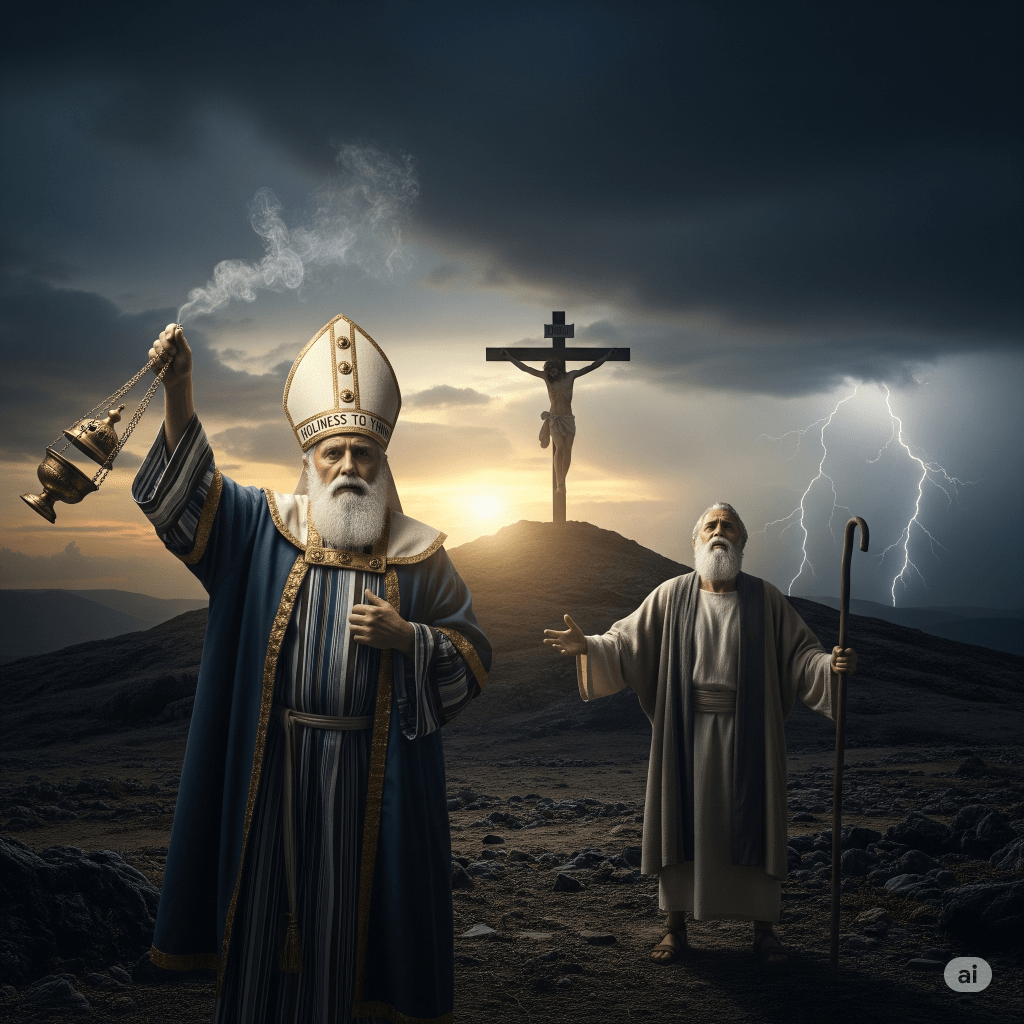
Aaron
A terrible rumble shakes the heights of Sinai –– a rumble so deep and sustained the Hebrews can feel it reverberate beneath their feet all the way into the camp. Shards of lightning rip through the desert sky, momentarily illuminating terrified faces before plunging them again into darkness. A thick, inky cloud forms around the peak of Sinai and begins to slowly descend the side of the mountain, ebbing and flowing across the arid sands toward the camp. A man turns to his wife and speaks in hushed tones, “This . . . this is not good.”
Another blast of lightning reveals the silhouettes of two men cast against the dark shadow of the mountain –– Moses and Aaron. Moses’s face is pressed against that of his brother. He shouts above the mounting fury and points frantically toward the Tent of Meeting. Yet another terrifying peal of thunder and a powerful flash illuminate the desert as if it were noon. Now, only the towering shadow of Moses is revealed. With arms outstretched toward the mountain, he shouts in the face of God, pleading. Then . . . as suddenly as it began, the storm subsides.
An oppressive silence replaces the fury of the storm. A gentle, almost pleasant breeze slowly pushes that dark cloud toward the edge of the camp. It reaches Dan on the north side of the camp first. Hanging low, like a morning fog, it spreads westward and eastward toward Ephraim and Judah. As the cloud envelops tent after tent, terror begins to run before it as men, women; whole families stumble and crawl into the open. Sucking in huge gulps of air in a vain effort to breathe, they bleed from their eyes and ears before collapsing, lifeless before the plague that has befallen them.
Yahweh has had enough.
The rocks and sand are unaffected as the dense cloud creeps through the camp, but every living thing dies as it is shrouded in its dark embrace. Sheep, goats, shrubs, insects, and men –– nothing is left alive as it passes. Slowly, relentlessly, the billowing cloud creeps across the ground, spreading wider and enveloping more and more of the Hebrew encampment.
Suddenly, the curtain at the entrance of the tabernacle is thrown back and old Aaron appears. He sprints northward, running as fast as his aging ankles will allow. He has his priestly robe gathered about his loins; his scarves and sashes are flying as he runs. His flowing white beard creeps up his chest and parts around his face and over his shoulders.
Just before the cloud overtakes the portion of the camp inhabited by Benjamin and Zebulon, Aaron takes up his place. Standing between the living and the dead, he waves his censer which he has filled with incense he has taken from the altar that stands just outside the holy of holies. The sweet fragrance that is the symbol of prayers lifted up to a holy God fills the air and right there . . . at the feet of Aaron the intercessor . . . the plague stops.
When God sent a great plague among the people because of their ungrateful grumbling, Moses instructed Aaron to go to the tabernacle and fill a censer with coals from the altar of incense. As the deadly plague spread slowly through the camp, Aaron brought the censer from the altar.
The incense that burned in the tabernacle was a symbol of the prayers that would rise up before the throne of God. The old priest stood there in the face of the wrath of God, waving the censer, spreading the aroma of that incense around him. And “the plague stopped.” (Numbers 16:48 NIV). In a symbolic portrayal of Yeshua, the High Priest who would come, Aaron positioned himself between a sinful people and the wrath of God. He offered not only the holy incense from the altar, but his own body that the people might be saved.
Moses
In a separate incident, when Moses came down from the mountain, he carried in his hands the Law of God; moral precepts etched in stone by the finger of God. Moses found the people dancing naked in a frenzied orgy around a golden calf which they now worshiped as a god. Yahweh was furious. In a billowing wrath He commanded Moses, “Get out of My way! I’m going to destroy them all!”
Moses’ response was quick and telling. Rather than stepping aside as ordered, Moses stepped in, choosing to stand between a wrathful God and a sinful people. He acknowledged their sin, but he pleaded for their lives that God might not destroy them. Moses, a living foreshadow of Christ the intercessor, interposed himself in the path of God’s wrath that the people might not be destroyed. He pleaded with God to spare them, even offering his own life in exchange for theirs, “Kill me instead!”
Jesus
The Son of God poured Himself into human flesh, taking the form of a servant and lived among us . . . as a man. Like Aaron and like Moses, he interposed Himself between heaven and earth, standing between divinity and humanity. He hung upon a cross between a holy God and a rebellious people and said, “Take me instead.” Jesus, the God-Man, absorbed the full fury of God’s wrath against the sinfulness of humanity . . . dying, that we might live.
Even now, Jesus sits at the right hand of the Father, interceding for us.
“But if anyone does sin, we have an advocate with the Father, Jesus Christ the righteous. He is the propitiation for our sins, and not for ours only but also for the sins of the whole world.” (1 John 2:1-2 ESV)
My brothers, we are not called to stand at the side of presidents and kings. The calling of the believer in this hour is far greater, far more demanding, than to sit in a palace or the Oval Office. Our vocation is much higher, for we are called to stand in the face of the impending judgment upon our rebellious nation and plead for mercy. In fact, Christian believers now occupy the highest, most vital office in the land –– the office of the intercessor. We are not called to rain down fire upon our political enemies, even those most reprehensible ones who teeter on the fringes of lunacy. We are called to intervene, to interpose our own lives for theirs, to intercede for the wickedest among us, crying out to God for mercy on their behalf.
Many of us who call ourselves Christians have chosen to leap into the political fray, spewing the same rancor, engaging in the same name-calling and political shaming as those who are not of faith. We happily post and repost witty comments and cruel memes in an effort to denigrate those we consider to be the enemy. We proudly name ourselves as members of the right wing, but to our shame, we have become the wrong wing.
Each of us must choose where we will stand. Will we stand in the role of judge, towering in smug, self-righteousness as the wicked are destroyed? Or, will we choose the role of intercessor, shouting in the face of God, pleading that He might spare even our enemy? An intercessor does not plead innocence. An intercessor acknowledges guilt while he pleads for mercy.
No, don’t pray that God will “make America great again.” Pray that God will open the eyes of our people so that we can see from where and from what height we have fallen. Pray that God will break the hearts of America, that God will pierce our souls with deep and profound conviction, even shame for our sin. Pray that the Holy Spirit will rip off the blinders of national pride and arrogance that cause us not to see our own wickedness and shame.
Will we run to stand between the living and the dead to offer up the incense of our prayers before God that the perverse plague of wickedness and spiritual blindness that has taken hold of our homeland may stop . . . and mercy might prevail?


Leave a Reply